|
 "Psychopaths are
increasingly common in business because they’re attracted to
the pace and volatility of today’s hyper-competitive
workplaces. And because companies unwittingly nurture them."
- Robert Hare, University of British
Columbia psychologist whose psychopathy checklist, the
PCL-R, used worldwide to screen for psychopathic
personalities. "Psychopaths are
increasingly common in business because they’re attracted to
the pace and volatility of today’s hyper-competitive
workplaces. And because companies unwittingly nurture them."
- Robert Hare, University of British
Columbia psychologist whose psychopathy checklist, the
PCL-R, used worldwide to screen for psychopathic
personalities.
By RAR
You
know the type. You see them heralded in those commercials
for National Car rentals. "You are a business pro,
executor of efficiency. You can spot an amateur a mile away,
while going shoeless and metal free in seconds..." They are
the people in your office who make all the money and get all
the perquisites, the rainmakers whom you would gladly kill
just to put them out of the misery they make for everyone at
or beneath their level on the organization chart, accept
that where ethical moral behavior and fully developed
conscience prevents you from doing anything so terrible you
suspect that the salesman of the month would have no such
qualms about putting the coffin screws to you, were it
necessary. It never will be, though, because you don't even
want to swim in the shark infested waters above your pay
grade. That can't be what life is about, not for you. That
is for those upwardly mobile assholes with the special deal
at National.
Have you noticed that all of the
remaining candidates for President of the United States are
people who personally have few-to-no friends?
When you let that sink in for a
moment, doesn't it seem odd? In a world where rising
successfully up through the ranks of your community and work
groups seems typically to depend upon your ability to "mix",
as my grandfather used to call it, the five remaining souls
who are vying to be the next President of the United States
are all lone wolves.
I base this observation of some
fairly flimsy evidence, but here it is: Barack Obama has
been largely ineffective in negotiating for Democratic
positions, often caving early, because he has no support web
out working the talk shows and supporting his agenda. In
fact, because he has been so noticeably absent from these aspects of
his communications program, it has created a sense that he
has no real agenda. Obama was a short-term back
bencher in the Senate with no D.C.-based team mates. He
actually tried, with a couple furtive social outreach
efforts in the first weeks of his administration, to be
chummy with the Washington elected elite but by all accounts
he didn't seem to enjoy the ordeal, so canceled further
socializing.
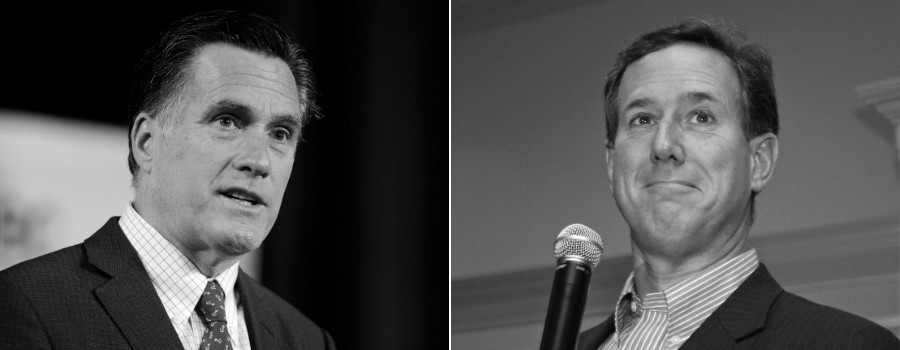
Mitt Romney was famously
unpopular with his co-competitors when he ran for the
Republican nomination in 2008, often photographed alone on
stage, left standing aside while the other candidates
scrummed in post-debate joviality. Romney clearly does not
connect to other humans, which would explain why he doesn't
see anything wrong with profiting ruthlessly from his
venture equity work with Bain Capital. One supposes that
history is filled with pirates of clear conscience, but that
provides no comfort for the number of people crushed under
the careless weight of Bain Capital's ambitions.
Rick Santorum was the least
liked guy in the Senate, when he was there, often viewed as
judgmental and scolding. Plus, he says nutty stuff, like
equating homosexuality with bestiality and other
perversities, and suggesting that university education is a
bad thing aimed largely as promoting the godless liberal
agenda. He is sufficiently off the deep end that no one of
any legitimate standing in the political world will have
anything to do with him.
Ditto for Newt Gingrich, who was
reviled right out of office in 1998, and continues to be the
least liked politician in America, among those famous enough
to be sampled. He has a following that relates to him,
not so much on a policy level, because he's all over the
board there, but on a level of bile and animosity. Newt will
actually say in public the terrible things that haters
everywhere would like to say if they weren't so well brought
up.
Then there is Ron Paul, whose
Mr. Magoo-country doctor image masks some seriously callous
attitudes toward his fellow man. He has a published record
of racist views against African Americans, and during the
debates earlier this year he showed a disturbing willingness
to throw the terminally ill to the wolves, or anywhere but
on the taxpayer's dime, with the expectation that somebody,
somewhere will do what they can to help them. But not the
government! Even his foreign policy is isolationist.
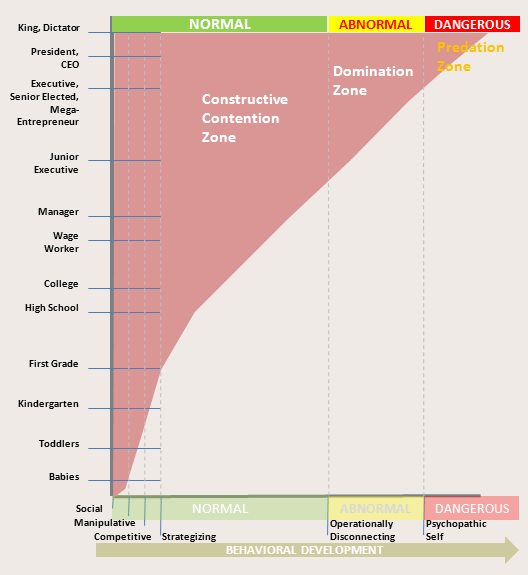
DISTURBING TRENDS: As the RCJ graphic above
intends to illustrate, there is a developmental arc that
accompanies age and experience, and intelligence - the
ability to manage one's environment - involves the
recognition, development and implementation of competitive
positioning skills. Deceit comes early to human beings, and
most people would admit to the importance that deception
plays in the management of our lives. It is extremely useful
in helping us to attain the milestones we reach on our way
to developing independence and standing in our communities.
Acknowledgement of deception and
its role within each of our lives is upsetting on a level
something like our recognition of the laws of the wild.
Animals eat other animals because that is what they are
wired to do. So it is with people, too. We recognize the
challenges and we adapt our approaches to fit the need, and
we do not spend a lot of time looking back. We need to stay
forward focused because each new day brings a new challenge.
Humans are a social species, and
clearly it is one that has thrived when it has worked in a
collective way that provided broadly distributed benefits.
The war production years and the post-World War II boom is
the most generally recognized example of this social
dynamic, which created the American middle class and made
the U.S. the preeminent economic power in the world.
The 1950s was a remarkably
"communal" decade characterized by the development of the
planned community and the notion of suburban living. This
was essentially a flat society where the guy who
owned the plant you worked at obviously got more than
you got out of the deal, but not that much more.
The new American economy worked
well for nearly 20 years after WWII, but things changed as
the economies of the rest of the world's leading nations,
many decimated during the war, began to fully recover to
challenge for a new global economy in which trade and
foreign policy were the principal considerations.
When history is written 100
years from now, I suspect we will look back on the 1960s as
the end of the American era. There were dramatic
symptoms of rottenness within, including assassinations and
neo-conservative entanglements abroad. While the machines of
industry drove us headlong into a costly war in Viet Nam,
many young people sensed that what their parents had given
up in the way of individual thinking, in order to be a part
of the upwardly mobile working class, was leading the nation
to ruin. There was a movement toward communal living, a sort
of extreme retaliation against the development of
insensitivities within the system that were driving people
apart. And living apart was increasingly more expensive. The
Hippie ethos, in retrospect, may have been little more than
low income people doing all they could do: commune.
Historians may also recognize
John F. Kennedy as the
first modern day President to have exhibited fundamentally
abnormal tendencies. Kennedy had performed heroically in the
Pacific during WWII, which given his family upbringing
further provided him with a resume that made him a natural
for the White House. Long before he won the presidency, but
long after he married Jackie Onassis in 1953, he became
broadly known as a serial philanderer, just as his father
had been. The Kennedys were ruthless, with Chicago gangland
and Hollywood connections, and their fortunes were made by
exploiting opportunities, as are those of all successful
business entrepreneurs. The ambition and lust spilled over
into their personal lives, and may have had something to do
with the assassination of JFK in Dallas in 1963.
America's executive branch
reached full-blown psycho with
Richard Nixon, particularly as he approached his
run for re-election in 1972. Referencing the chart above,
where Kennedy had probably moved somewhere into the lower
reaches of the Domination Zone - referencing his
personal relations, including his "alliance" with Vice
President Lyndon B. Johnson - Richard Nixon had gone bull
goose loony, all the way into Predation territory.
Also known to have mob connections, his to the Miami
syndicate, Nixon may well have been capable of anything,
stopped only by Nixon's own self-appointed
Ervin Committee, which
hounded him from office.
Gerald
Ford was a genial accident of history not at all
representative of any aspect of America in his time, but
Jimmy Carter was the first
of the outsider candidates: the candidate who ran for the
highest office in the land on the promise that he didn't
know anybody in Washington D.C. There were two disturbances
at work in Carter. One was that such a candidacy is, at
heart, a lie because once elected a president surrounds
himself with Washington D.C. expertise to figure out how to
operate within that environment. The second was that Carter,
the former Governor of Georgia, really was an outsider, and
by choice. Rather like Obama, Carter got next to nothing
accomplished other than dismantling regulatory structures in
the transportation and communication industries. He has
spent the rest of his life as a renegade policy advocate and
do gooder who has somehow still never managed to ingratiate
anyone to him. He is probably the least liked humanitarian
in history.
Ronald
Reagan was well into the Operationally
Disconnected Domination zone dating clear back to his
time as Governor of California. He was too basically kind of
nature to veer toward psychotic behavior, but many describe
meeting him as an exercise in mirror talk, like attempting
to have a conversation with someone who really isn't there
in the same room with you, at least in his thinking.
George
H.W. Bush was disconnected by privilege.
Bill Clinton is probably
truly psychotic, but governed by an intellectual nature that
includes a talking truce with going too far.
Have you ever noticed how, in an interview, Clinton seems
just a few ticks off, like he is always thinking about his
next answer to a question that has not yet been asked, so it
takes a few beats for him to respond to the unexpected? The
collegial Bill often seems at war with himself.
George
W. Bush was probably not psychotic, but he was
certainly creepy. A "W" speech was an exercise in awkward
pauses, misspoken words, and non sequitur connections. He
seemed often to be listening to a voice in his head, sort of
wobbling under the weight of the information being provided.
On the other hand, maybe he was psychotic: he murdered
thousands of people in Iraq based on knowingly false
information and deceit, all apparently for the reasons one
might attribute to a deranged son of a powerful father.
And now we have
Barack Obama, who seems
only to come to life when he is in speech mode, but otherwise
disappears behind the scenes. He has surprised his
supporters with his lack of purpose, his reasons for wanting
to be President at least as vague as Mitt Romney's, whose
are often cited against him.
Barack Obama has done one thing
that truly puts him in a special class that may be in the
psychotic range: he has embraced assassination, military
victory by quick and decisive murderous action. He sends
special forces into places to shoot to kill. He attacks
targets with unmanned drone craft. These are not the modus
operandi of a Commander-in-Chief so much as they are Mafia
chief.
What is equally fascinating, at
least to me, is that these global assassinations that have
been carried out under Obama's watch - and which have been
mirrored by murders in Iran, Iraq, Afghanistan, Pakistan,
Israel and elsewhere - are now embraced by the Liberal
establishment as the primary accomplished of the first term
of the Obama Administration.
While we have embraced psychotic
behavior in our actions against enemies abroad, Obama has
embraced some extremely callous behavior on all sorts of
domestic fronts. He has:
-
Guaranteed drug prices for
U.S. pharmaceutical companies and denied customers less
expensive alternatives
-
Mandated that adults
purchase private health insurance, knowing that it is
out of range price wise for many people
-
Proposed cutting government
spending by trimming funds to Medicare
-
Expanded drilling for oil
and natural gas in U.S. territories, including Gulf
Coast waters, even while having the Deep Horizon
catastrophe happen on his watch
-
Dropped support (early on)
for the carbon emissions cap-and-trade system that would
have created a systematic means to gradually reduce
greenhouse gas in the environment
FINALLY... We are going to look up, after the
November election, and realize that whoever we have elected
is essentially at odds with who each of us individually
probably purports to believe we are as a people.
Why this has happened is a
question for the ages, and one senses it will be too late
before the majority of us realize that it has. America will
have become a much tougher, much poorer place.
We have created a society in
which a person's value is based entirely upon his or her
income, or ability to create wealth. And we have limited the
options for earning income and creating wealth to a very few
streams of endeavor, having largely to do with an exodus of
jobs in the manufacturing sector.
Worst of all, we have
green-lighted a predatory society with an economy 70-percent
dependent upon churn; not investment and savings, but
just re-circulating money through the system so that
payrolls get met and the people at the top get their cut.
To maintain that level of
ruthless spending requires manipulations of the markets
through the finance industry, and manipulations of the
buying public through advertising and promotions.
All of those drivers are
indicators of mental illness, a vain narcissism veering
toward psychosis.
One sense that America has lost
the mooring that might keep it from electing the candidates
that we have, and limiting ourselves to extreme cases of
personality disorder, but they - those we hoist into
leadership positions - reflect who we are as a people.
We are the product of an
economic system that endorses anti-social behavior, and one
suspects it will still be awhile before we realize what we
have wrought.
Somehow we need to begin to
envision a better future with higher moral imperatives.
It is not likely to emerge from
our current crop of über-business achievers, of psychos.
(022612)
|
 www.
www.

 We
Need A New Party!
We
Need A New Party!