“American Exceptionalism” – a kind of multi-interpreted myth created by the French political writer Alexis de Tocqueville – has been among the squishiest concepts ever created, especially as it has been applied to America’s prison system.
By RAR
The writer de Tocqueville was referencing America being founded on “ideals” rather than “bloodlines”, which speaks volumes about how the world has largely operated. His coined phrase has been used in a variety of ways over the years, sometimes as a sarcasm, but other times as a boast, including a prideful boast about America’s prison systems.
America began imprisoning people like mad in the 1970s. We turned prison operations into commercial ventures, often as foundational employment opportunities for small communities in the middle of nowhere. Some sociologists began to say things like “If you want to see American exceptionalism, look at its prisons.”
I guess that was meant as a compliment, but in practice it meant that the U.S. built the largest prison system in human history. Our incarceration rate became 5–10 times higher than Western Europe. By the 2000s, the U.S. imprisoned more people than any country on earth, including authoritarian states.
“Law and order Republicans” loved the mandatory minimums, three‑strikes laws, and truth‑in‑sentencing, all uniquely American concepts. They didn’t seem to mind the racial disparity this prison zeal encouraged. Black Americans were incarcerated at 5 times the rate of white Americans—another “exceptional” statistic.
Entire rural economies became dependent on prisons for local employment, something almost unseen in other democracies. Thinking, on the subject, became really twisted. By the 2000s, scholars like David Garland, Marie Gottschalk, and Loïc Wacquant argued that mass incarceration was the clearest modern expression of American exceptionalism.
What it really was, and is, is American capitalism at work. Private companies figured out that there is big money to be made in running prisons, providing they could be run at scale. You need a lot of convicts to make these prisons viable employment generators.
It is a lot like job-creating human slavery.
Presently in California, there are 90,035 people behind bars. Of those, only one-third, 29,712 are convicted of violent crimes. The vast majority are non-violent offenders.
It costs $127,800 each year to take care of each those 90,035 convicts. That’s $11.5 billion per year.
I am all for harsh punishments for law breakers, but I think incarceration should be reserved for people too dangerous to have free on public streets.
Of the non-violent convicts, 40–45 percent are in for property crimes, like burglary. Drug crimes put 25–30 percent behind bars. Fraud/financial crimes landed 10–15 percent in prison, non‑violent weapons offenses another 10 percent, and other non-violent felonies accounted for 5–10 percent.
Those people should all be required to account for their behaviors, preferably by paying back to society, in some form, to atone for their transgressions. Some of them are probably criminally-smart and could be steered into more positive opportunities for growth. A lot of them could probably benefit from job training. Some of them should face travel restrictions and have their business transactions closely monitored. We should have aggressive probation services watching these people closely, and we should be offering community services, helping to make sure that they don’t commit additional crimes because they haven’t been equipped with better ideas. We should be focusing on job training and placement.
If we cut the prison population in California from 90,035 to just the 29,712 goons who must be behind bars, we could save a whopping $7.8 billion annually.
Now here is the thing. If we were to cut the prison population by that much, it would have a tremendous impact on a prison system that is the lifeblood of many California communities.
Because most costs are fixed (staff, buildings, health care infrastructure), that kind of reduction cannot be absorbed just by trimming food and clothing. It would almost certainly mean closing multiple prisons, eliminating thousands of positions, shrinking local economies in prison towns.
Recent reporting estimates that closing one state prison saves about $150 million per year and affects 1,000–2,000 staff jobs at that facility, plus ripple effects in the surrounding community.
California currently operates 31 prisons. With the population cut to one‑third, the state could theoretically consolidate inmates into far fewer facilities, and close a significant number of prisons (potentially 10–20, depending on capacity and design).
That would mean direct job losses or forced transfers for thousands of correctional officers, nurses, clerical staff, maintenance workers, and program staff. There would be secondary job losses in nearby towns (restaurants, retail, services that depend on prison payroll).
Custody and security jobs would be cut as housing units and entire prisons are deactivated. Health care and support staff would shrink with fewer inmates and fewer operating facilities. Local economies in rural prison towns would take a hit; prisons are often among the largest employers.
THE SOLUTION
To actually make any progressive gains, we would need to reinvest that $7.8 billion in savings into the communities that would be impacted by prison closings.
There have been studies done on this. To offset the economic upheaval of closing prisons, we would have to do the following:
- Keep non‑violent people out of prison – spend $2.08 billion on community treatment & diversion programs
- Stabilize people leaving prison – spend $1.5B of the savings on reentry & housing
- Reduce future violent crime – spent #1.2 billion on violence prevention & youth programs
- Direct support to those harmed by crime – spent $0.5 billion on victim services & restitution
- Replace prison-based jobs – $1.5 billion for economic transition for prison towns
- Investment in long-term human capital – $1.0 billion for education & job training (inside & outside the prison system)
Hard-on-crime Republicans will likely say “Well there go the savings and all we have is a bunch more criminals on the streets”.
A progressive would likely argue that investing $7.8 billion in community development makes a lot more sense than spending that same money so that non-violent criminals can rot in a prison cell.
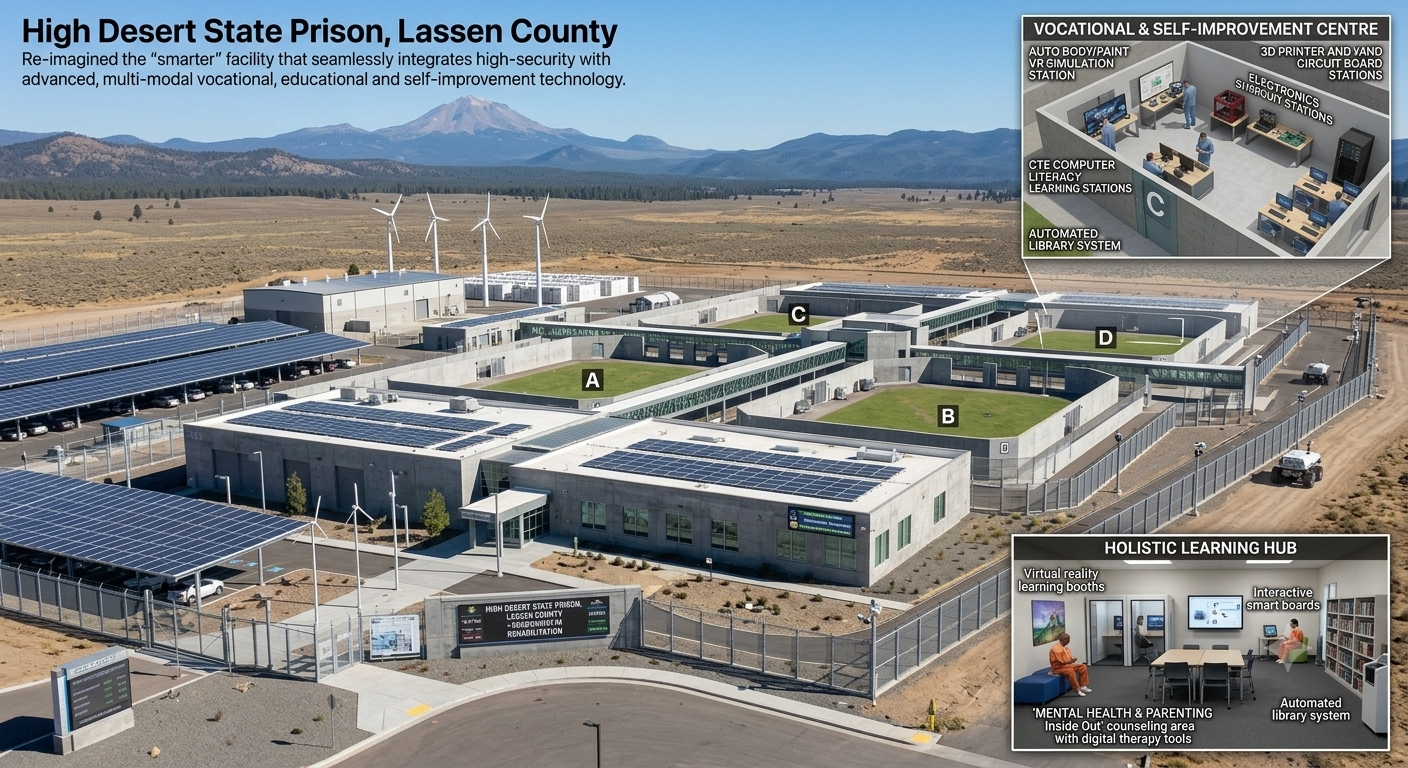
You can game play it easily enough. I ran a little thought exercise with an AI chatbot, using the prison in Lassen, California as a test case.
THE LASSEN EXPERIMENT
Let’s zoom in on Lassen County, home to High Desert State Prison and the now‑closed California Correctional Center (CCC) in Susanville. CCC’s closure already gave us a preview of what a “post‑prison” transition looks like when the state doesn’t fully plan for it.
1. Framing the problem in Lassen County
Context:
- Population: ~30,000
- Economy: heavily dependent on state prisons, local government, timber, and small retail
- CCC closure: removed hundreds of jobs; High Desert remains, but any future downsizing would deepen the shock
In a “violent‑only incarceration” scenario, California could close multiple prisons. Lassen is exactly the kind of place that needs intentional transition, not just a budget line that says “facility deactivated.”
2. A concrete transition plan for Lassen County
Think of this as a 10‑year, multi‑phase strategy funded from that $1.5B “economic transition” bucket we sketched.
Phase 1: Stabilization (Years 1–2)
Goals: Stop the free‑fall; keep families from leaving en masse.
- Bridge payroll support:
- Temporary state stipends for laid‑off correctional staff while retraining pathways are built.
- Example: $50–$75M over 2 years for Lassen and similar counties.
- Local government backfill:
- Direct grants to the city of Susanville and Lassen County to offset lost tax and spending.
- Keep schools, clinics, and basic services from cutting deep.
- Economic impact assessment:
- Detailed mapping of which sectors depended most on prison payroll (housing, restaurants, auto, retail).
- Use this to target support, not just spray money.
Phase 2: Workforce transition (Years 2–6)
Goals: Turn “prison workers” into “future‑sector workers” without forcing them to move away.
- Retraining guarantees for correctional officers and staff:
- Priority pipelines into:
- Behavioral health (substance use counselors, psych techs, crisis workers)
- EMS and healthcare support (paramedics, medical assistants, CNAs)
- Trades and infrastructure (electricians, solar installers, broadband techs)
- Wildfire and forest management (CalFire, conservation crews)
- Priority pipelines into:
- Paid training + placement:
- Tuition‑free programs at local community colleges or satellite campuses.
- Stipends during training so people don’t have to choose between learning and feeding their families.
- Formal agreements with state agencies and private employers to hire graduates.
- Use prison skills as assets:
- Many correctional officers already have:
- Crisis management
- Report writing
- Security protocols
- Team coordination
- Reframe those as public safety, health, and logistics skills, not dead‑end experience.
- Many correctional officers already have:
Phase 3: New anchor industries (Years 3–10)
Goals: Replace “prison as anchor employer” with multiple, future‑proof anchors.
Some realistic candidates for Lassen:
- Renewable energy & transmission:
- Utility‑scale solar or wind projects on suitable land.
- Grid and transmission upgrades using former prison‑adjacent infrastructure.
- Jobs: construction, maintenance, operations.
- Forest management & wildfire resilience:
- Regional hub for:
- Fuel reduction crews
- Prescribed burn teams
- Timber and biomass innovation
- Jobs: field crews, planners, equipment operators.
- Regional hub for:
- Remote work & digital hubs:
- Convert part of the former prison or other public buildings into:
- Co‑working spaces
- Data centers or remote operations hubs
- Pair with rural broadband expansion so residents can work for companies based in SF, LA, or beyond.
- Convert part of the former prison or other public buildings into:
- Outdoor recreation & tourism:
- Invest in trails, lakes access, small‑scale lodging, and marketing.
- Jobs: hospitality, guiding, maintenance, small business.
Each of these would be backed by state capital investment plus private‑sector incentives (tax credits, grants, low‑interest loans).
Phase 4: Repurposing prison infrastructure
Goals: Make sure the old prison doesn’t just sit there like a concrete tomb.
Options for CCC‑style facilities:
- Training and resilience campus:
- Multi‑agency hub for:
- Fire training
- Emergency response drills
- Behavioral health and crisis intervention training
- Keeps some jobs on site, but with a different mission.
- Multi‑agency hub for:
- Mixed‑use redevelopment (longer‑term):
- Selective demolition + reuse of utilities, roads, and secure perimeters.
- Could host:
- Light industrial
- Logistics
- Storage
- Renewable energy operations
The key is: don’t leave a dead building as a symbol of abandonment.
3. How the money actually flows
From that $1.5B annual transition bucket, a county like Lassen might see:
- Years 1–2: $50–$100M
- Bridge payroll, local government stabilization, planning.
- Years 3–10: $50–$150M total
- Workforce programs, infrastructure, anchor industry development, repurposing facilities.
Spread across multiple prison‑dependent counties, you’re talking about multi‑hundred‑million‑dollar commitments per region, not token grants.
4. What success would look like in Lassen
Ten years in, a successful transition would mean:
- The county’s population hasn’t collapsed.
- Former prison staff are now:
- Firefighters, paramedics, counselors, tradespeople, grid techs.
- The old prison site is:
- A training campus, energy hub, or mixed‑use facility—not a ruin.
- Local businesses:
- Survived the shock and now serve a more diversified workforce.
- The county’s identity:
- Shifted from “prison town” to “resilience and energy hub” or “forest and fire expertise region.”
The deeper move here is moral as much as economic: If California decides to cage fewer people, it has to refuse the old pattern where rural towns are used, then discarded.
We can absolutely design a future where less incarceration means:
- More meaningful work
- More stable communities
- More safety rooted in care and prevention, not just concrete and razor wire
FINAL THOUGHT
To me, we can either build a society on backwards-thinking make-work jobs, that in the case of prison incarceration leave lasting deleterious impacts on those incarcerated, and on those whose job is to maintain their incarceration.
In our current scenario of exceptionalism, the focus is not on development, but rather on a kind of rigged opportunism that perpetuates a criminal sub-class.
That’s not exceptional. America can do better.