
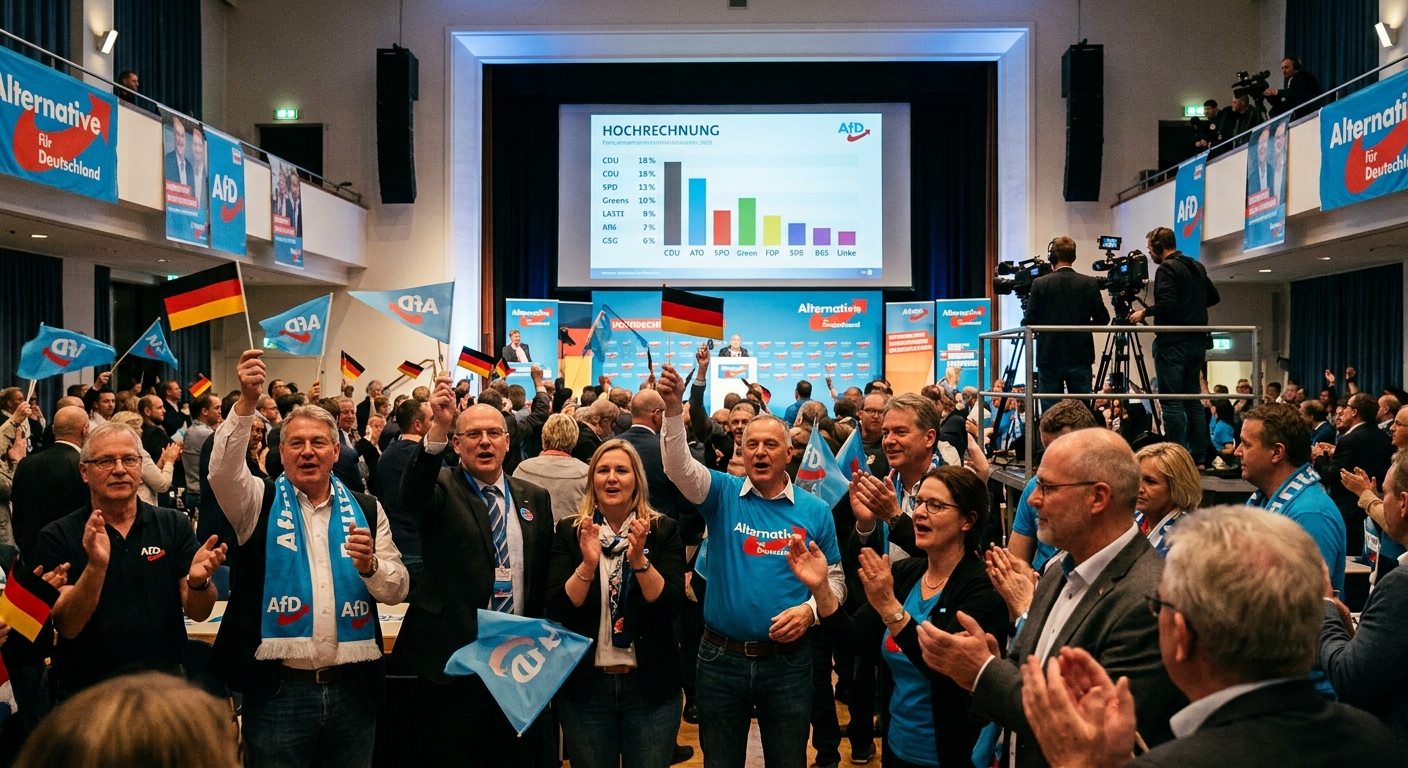
The rise of the AfD (Alternative für Deutschland political party) does not mean that Germany is about to abandon Ukraine or NATO. But it does suggest that the political consensus sustaining Europe’s confrontation with Vladimir Putin is becoming more fragile—and that may be almost as important.
There are moments in European politics when an election produces a government. And there are moments when an election produces something more unsettling: a change in what suddenly seems politically possible.
The victory of the Alternative für Deutschland in Saxony-Anhalt belongs to the second category.
The AfD received approximately 44 percent of the vote, winning 39 of the state parliament’s 83 seats. The Christian Democratic Union, once the natural party of government in Germany, finished a distant second with about 17 percent. The AfD therefore did not quite win an outright majority, but it came close enough to expose the extraordinary transformation taking place inside one of Europe’s most consequential political systems.
That transformation is frequently described as Germany’s turn to the right. This is true, but incomplete. The deeper story concerns the unraveling of a postwar German assumption: that Germany’s security, prosperity, and political identity are inseparable from the Western alliance and from the European project.
The AfD does not share that assumption.
Its foreign-policy program calls for an improvement in relations with Russia, the lifting of European sanctions, renewed economic relations with Moscow, and a broader European security arrangement in which Russia is again incorporated rather than permanently excluded. The party has also opposed the expansion of NATO’s role beyond what it regards as the territorial defense of its members.
That is not merely a disagreement over Ukraine.
It is a different theory of Europe.
The German question returns
For three-quarters of a century, Germany’s political establishment behaved as though the country’s greatest achievement was not simply becoming prosperous, democratic, and peaceful, but becoming predictably Western.
The Federal Republic’s identity was constructed around institutions that constrained German power: NATO, the European Union, the transatlantic alliance, and an increasingly integrated European economy.
Germany was powerful, but it was not supposed to behave like a traditional great power.
Russia complicated this arrangement long before Vladimir Putin’s full-scale invasion of Ukraine. For decades, German governments pursued the idea that economic interdependence could moderate geopolitical rivalry. Cheap Russian energy flowed westward; German industrial goods flowed eastward. The resulting relationship was sometimes summarized by the phrase Wandel durch Handel—change through trade.
The invasion of Ukraine shattered the premise.
The German government now describes Russia as the principal direct security threat to Europe and has embraced a substantial expansion of German defense capabilities. Berlin says Russia has conducted or supported cyberattacks, sabotage, disinformation, and other forms of hybrid warfare against European states.
The AfD’s political ascent is therefore occurring against a remarkable historical reversal: the Germany that spent decades trying to make Russia economically dependent upon Europe is now being asked to help protect Europe from Russia.
And a growing portion of the German electorate is asking whether that reversal has gone too far.
What the AfD actually wants
It would be a mistake to interpret the AfD’s position as simply “pro-Russian.”
The party describes its objective in terms of German sovereignty and strategic autonomy. It argues that Germany should maintain good relations with both Washington and Moscow, and that Europe ultimately needs a security order that includes Russia. Its program explicitly calls for an end to EU sanctions against Russia and the development of economic relations, including support for Nord Stream 2.
In practice, that would represent a dramatic change.
Ukraine’s survival as a sovereign state has become intertwined with the European security order. If Germany were to conclude that the war should end primarily through accommodation with Moscow—even at the price of Ukrainian territorial concessions—the consequences would extend far beyond Ukraine.
They would reach Poland, the Baltic states, Finland, Romania, France and Britain. They would reach NATO itself.
The fundamental question would become: What does Europe believe Russia is entitled to demand from its neighbors?
That is why the German election matters even though it occurred in a single eastern state.
The temptation of the Russian bargain
There is an understandable argument behind the AfD’s position.
Germany is an industrial country. Energy prices matter. Defense spending is expensive. The war in Ukraine has produced enormous economic and political costs. Russia is geographically permanent. And unlike an American administration, a German government cannot simply decide that Russia is an ocean away.
Eventually, the argument goes, Europe will have to coexist with Moscow.
This is true.
But coexistence and accommodation are not the same thing.
The dangerous version of the Russian bargain would proceed from the assumption that Europe’s security can be purchased by giving Moscow some of what it wants. Perhaps Ukraine would be forced into a settlement. Perhaps sanctions would gradually disappear. Perhaps Russian energy would return to European markets. Perhaps NATO would quietly reduce its military posture along Russia’s western frontier.
Such an arrangement could produce peace.
It could also produce something more dangerous: a Russia that concludes that military pressure works.
That distinction is central to the future of Europe.
The war is already spilling across the border
The possibility of a broader European war does not begin with Russian tanks crossing a NATO frontier.
In some ways, it has already begun.
NATO says European countries are experiencing increasing cyberattacks, sabotage, assassination attempts, infrastructure disruptions, disinformation campaigns and other hostile activities that it attributes to Russian operations. The alliance describes the current environment as one in which Europe is “not at war, but … not at peace either.”
Germany has recently accused Russia of involvement in an attempted drone attack near Leipzig/Halle Airport. Berlin has responded with diplomatic and security measures, including plans to close Russia’s consulate in Bonn and terminate the lease of the Russian House in Berlin. Moscow denies the accusation.
This is precisely the gray zone in which modern European conflict is likely to develop.
The next European crisis may not begin with an invasion. It may begin with a power outage, a cyberattack, sabotage of transportation infrastructure, interference with an election, an assassination attempt, or an incident involving aircraft or drones.
The strategic objective need not be to conquer a country.
It may simply be to demonstrate that European governments cannot protect their own societies.
The greatest danger may be political fragmentation
This is where the AfD’s rise becomes strategically important.
Russia does not necessarily need Germany to become an ally.
It may be enough for Germany to become divided.
If Berlin is arguing with Warsaw about Ukraine, Paris is arguing with Berlin about Russia, Eastern European governments are demanding stronger NATO defenses, and Western European voters are demanding negotiations, the alliance becomes progressively harder to operate.
This is the logic behind Russian political influence that Western governments have worried about for years: not necessarily converting European democracies into Russian satellites, but making collective action sufficiently contentious that Europe becomes strategically paralyzed.
NATO itself has warned that Russia seeks not only military advantage but the weakening and division of the alliance.
The AfD need not be controlled by Moscow for its political success to have that effect. A democratic political movement can independently arrive at conclusions that happen to benefit an adversary.
That is one of the uncomfortable features of modern geopolitical competition.
Influence does not require obedience.
How likely is a wider European war?
The probability should not be exaggerated.
A direct Russian attack on NATO would still be an extraordinarily consequential decision. NATO possesses enormous military capabilities, and its members have been strengthening their deterrence posture precisely because of the Russian threat.
Russia also has enormous reasons to avoid a war with the entire alliance.
So the most plausible danger is not a deliberate decision by Moscow to launch a continent-wide war.
It is escalation by increments.
Imagine a chain of events in which Russia conducts increasingly aggressive hybrid operations; European countries respond; an operation causes casualties; NATO retaliates in a limited fashion; Moscow responds somewhere else; political factions inside Europe demand restraint; other factions demand escalation.
Eventually, leaders may discover that the space for backing down has become smaller than the space for moving forward.
That is how great-power wars have often begun—not because every participant wanted a general war, but because successive crises made retreat politically impossible.
My rough assessment
If one is forced to put numbers on an inherently uncertain question, I would distinguish three risks:
A direct Russia-NATO war in the next two years: perhaps 10–15 percent.
That is dangerously high by historical standards, but still means that a direct continental war is considerably more likely not to occur than to occur.
A major escalation involving Russian attacks or coercive operations against NATO countries that produces a serious military confrontation: perhaps 20–30 percent.
This category includes incidents that fall short of a deliberate invasion but nevertheless produce casualties, military retaliation, or an extended confrontation.
A continuing expansion of Europe’s “gray-zone” conflict—cyberattacks, sabotage, political interference, infrastructure attacks, espionage, disinformation and other coercive activity: well above 50 percent.
Indeed, much of this is already happening.
These are not predictions so much as ways of expressing the asymmetry of the danger.
Europe does not need to become a battlefield tomorrow for its security environment to deteriorate substantially.
Germany is the hinge
The most consequential question may therefore not be whether the AfD eventually forms a government.
It is whether the political ideas represented by the AfD migrate into the mainstream.
The firewall surrounding the party remains intact. Friedrich Merz has rejected cooperation with the AfD despite the electoral shock.
But electoral victories change political gravity.
If mainstream parties conclude that they must adopt some AfD positions to prevent voters from defecting, the AfD can influence German policy without ever entering government. If its success continues, future German elections could become referendums not only on immigration but on the country’s relationship with NATO, the EU, Ukraine, and Russia.
And Germany is too large for that argument to remain German.
A Germany that becomes more skeptical of Ukraine will place pressure on France. A France that responds by demanding greater European military independence will unsettle Poland. Poland will look eastward and demand greater American protection. Eastern European governments will become less willing to trust Berlin. Washington will have to decide whether Europe is capable of defending itself. And Moscow will study every disagreement.
The resulting instability could become self-reinforcing.
Europe is entering the dangerous middle
There is a tendency to imagine European security as a choice between peace and war.
That is too simple.
Europe can exist for years in an intermediate condition: technically at peace, but increasingly unstable; formally united, but politically fractured; economically interconnected, but strategically suspicious.
That may be the condition Europe is entering now.
The AfD’s victory does not mean Germany is returning to the 1930s. Such historical analogies are usually more illuminating as warnings than as explanations. Germany remains a constitutional democracy with powerful institutions, a deeply rooted European identity, and a political establishment that has so far maintained its prohibition on cooperation with the far right.
But the old German political consensus is visibly weakening.
And the question posed by the AfD is not merely whether Germany should admit fewer immigrants or spend less money abroad.
It is a much larger question:
What kind of Europe should exist after the war in Ukraine?
One possibility is a Europe that regards Russian aggression as the decisive lesson of the past five years and builds a stronger military and political union around deterring Moscow.
Another is a Europe that concludes that the war has become too costly and that security requires a new accommodation with Russia.
A third possibility is more troubling: Europe becomes incapable of agreeing on either.
That is the scenario worth watching.
Because if Europe fractures politically while Russia remains willing to exploit those divisions, the danger is not necessarily that someone decides to start a European war.
It is that everyone keeps taking one more step into an increasingly dangerous landscape—and eventually discovers that the continent has wandered somewhere no one intended to go.