
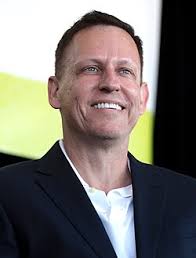
The PayPal founder, venture capitalist, Palantir chairman, political patron, and apocalyptic Christian thinker may be one of the most consequential—and least understood—figures in American life.
There is a peculiar test one can administer to the average American. Ask about Elon Musk and the answer will probably arrive before the question has been completed: Tesla, rockets, Twitter—or X, or whatever it is called now. Ask about Mark Zuckerberg and the answer will involve Facebook. Ask about Jeff Bezos and there will be Amazon, or perhaps space.
Then ask about Peter Thiel.
The silence can be remarkable.
This is strange because Thiel belongs to a rather small category of people who have repeatedly been present at the creation of things that became vastly larger than themselves. He co-founded PayPal. He was its chief executive when it was sold to eBay. He became the first major outside investor in Facebook. He co-founded Palantir, the enormously consequential data-analysis and defense company. He helped create Founders Fund, one of the most influential venture-capital firms in Silicon Valley. His investments and protégés have spread through artificial intelligence, aerospace, defense, finance, social media and biotechnology.
And then there is politics.
Thiel did not merely write a check to J. D. Vance. He helped construct the institutional bridge by which Vance moved from being a lawyer and author into Silicon Valley, venture capital and eventually national politics. Vance worked at Thiel’s Mithril Capital; Thiel provided early backing to Vance’s venture firm, Narya Capital; and in 2021 and 2022 Thiel gave $15 million to a super PAC supporting Vance’s successful Senate campaign. When Donald Trump selected Vance as his running mate in 2024, Thiel was among the Silicon Valley figures who had already spent years cultivating the relationship.
Gil Durán, the journalist and author of The Nerd Reich, goes considerably further. He has characterized Vance as almost entirely a creation of Thiel’s political and intellectual network. That is deliberately provocative language. Vance obviously had a life before Thiel, and it would be an exaggeration to attribute his entire career to one benefactor. But the underlying observation is difficult to dismiss: Thiel did not simply discover Vance after he became powerful. He invested in him while he was still becoming powerful.
That distinction is central to understanding Thiel.
He is less interesting as a billionaire than as a builder of other people’s power.
The Stanford years
Thiel’s story begins, intellectually, at Stanford.
He arrived at the university in the 1980s, studied philosophy, and helped establish the Stanford Review, a conservative student newspaper that challenged what he and his colleagues regarded as the dominant political culture on campus. He later attended Stanford Law School. The Review became more than a college newspaper. It became an early node in a network of people who would eventually occupy remarkably influential positions in Silicon Valley.
This is one of the keys to Thiel’s career: he has always understood networks as institutions.
At Stanford, friendships became an intellectual network. At PayPal, employees became investors and entrepreneurs. At Founders Fund, investment became ideological selection. In politics, financial support became mentorship and recruitment.
Silicon Valley tends to tell its history as a succession of heroic individual entrepreneurs: Jobs, Gates, Zuckerberg, Musk. Thiel’s history looks different. It resembles a family tree.
The PayPal generation is the most famous example. Thiel, Max Levchin, Elon Musk, David Sacks, Reid Hoffman, Keith Rabois, Peter Thiel’s other colleagues and associates went on to create or finance companies ranging across the technology economy. The phenomenon became known as the “PayPal Mafia.”
The joke about the mafia contained a serious insight. The important product of PayPal was not merely PayPal.
It was people.
PayPal, Musk, and the first great Thiel network
The relationship between Thiel and Musk is particularly revealing.
Musk is often remembered as the dominant personality of PayPal’s early history, but the actual corporate history was more complicated. Musk’s X.com merged with Confinity, the company founded by Thiel and others, and Thiel eventually became CEO of the combined company. PayPal was subsequently sold to eBay in 2002.
Musk walked away with money and the beginnings of the fortune that would eventually finance Tesla and SpaceX.
Thiel walked away with something different.
He had discovered that a relatively small amount of capital, placed behind unusually ambitious people, could produce enormous downstream influence.
His subsequent career became an experiment in that proposition.
In 2003, he helped found Palantir. In 2004, he invested $500,000 in Facebook, becoming its first outside investor. He later helped establish Founders Fund, whose investments included SpaceX and other companies that would become major technology enterprises.
Musk became famous by building spectacular machines.
Thiel became powerful by learning where to put the money before the machines existed.
The investor who became an ideology
Thiel’s investment philosophy is inseparable from his political philosophy.
His famous book, Zero to One, presents technological progress as the creation of something genuinely new rather than the incremental improvement of what already exists. His worldview places enormous emphasis on technological acceleration, monopoly, entrepreneurship and the capacity of exceptional individuals to escape the constraints imposed by conventional institutions.
This is where Thiel begins to depart from the ordinary Silicon Valley libertarian.
He is not simply a businessman who thinks government should get out of the way. He has developed a much more sweeping critique of liberal democracy itself.
In a 2009 essay, Thiel argued that the expansion of democracy and the franchise had contributed to what he regarded as an increasingly hostile environment for capitalism. He subsequently became associated with Curtis Yarvin, the influential anti-democratic theorist whose writings advocate replacing democratic government with highly centralized forms of corporate or monarchical rule. Durán’s reporting places this intellectual relationship near the center of the contemporary Silicon Valley right.
This is one reason Thiel is worth studying separately from Musk.
Musk’s politics often appear improvisational. Thiel’s are considerably more intellectualized.
He has spent decades thinking about the problem of political authority, technological stagnation, individual freedom, democracy and the possibility that the existing political order is incapable of producing the future he wants.
That makes him harder to understand—and potentially more consequential.
Why does almost nobody know him?
Part of the answer is that Thiel does not need fame.
Fame is useful when one needs an audience. Thiel’s preferred audience is smaller: founders, investors, politicians, academics, journalists, intellectuals and people who may become powerful later.
His preferred medium is therefore not the social-media feed but the private dinner.
He has repeatedly invested in people at an early stage, when they were cheap, obscure and still forming their identities. By the time the public notices them, Thiel’s fingerprints can be several stages removed.
This is a particularly efficient form of power.
The conventional celebrity billionaire says: Look at me.
Thiel’s model is closer to: Look at what I helped make possible.
It is also why attempts to understand Silicon Valley by focusing only on its most visible personalities can be misleading. The person giving the interview may not be the person who supplied the original capital, introduced the crucial colleague, recommended the political candidate, or created the intellectual environment in which the eventual decision became thinkable.
Thiel has often occupied precisely that upstream position.
J. D. Vance as the case study
Vance may be the clearest example.
Before entering national politics, Vance was best known as the author of Hillbilly Elegy. He subsequently entered the venture-capital world, working with people connected to Thiel and joining Mithril Capital. He co-founded Narya Capital with Colin Greenspon, a former Mithril colleague, and Thiel supplied at least part of Narya’s initial capital.
Then came politics.
Thiel gave $15 million to a super PAC supporting Vance’s 2022 Senate campaign. That was an extraordinary financial commitment to a candidate who had never held elective office.
The significance was not simply the amount of money.
It was the sequence.
Thiel had helped create a pathway:
author → venture capitalist → Thiel network → political candidate → national political figure.
Durán’s formulation—that Vance was almost entirely a Thiel creation—is rhetorically stronger than the evidence permits if taken literally. But it captures something important about modern political power: a politician’s career can be constructed through a series of private institutions long before voters encounter the politician on a ballot.
And Vance himself has acknowledged the intellectual importance of Thiel. The Washington Post reported that Vance regarded a 2011 Thiel speech at Yale Law School as the most significant moment of his time at Yale.
The pupil, in other words, did not merely receive money.
He received a worldview.
Religion, technology and the Antichrist
This is where Thiel’s story becomes stranger.
Thiel has long identified as a Christian, but his Christianity does not fit comfortably into the conventional categories of American evangelical politics. One of the major influences on his thinking has been René Girard, the French intellectual whose theories of mimetic desire, violence and scapegoating have deeply influenced Thiel’s understanding of history.
In recent years, Thiel’s religious thought has become increasingly public—and increasingly apocalyptic.
In 2025, he delivered a series of private lectures on the Antichrist in San Francisco. Recordings obtained by the Washington Post revealed a worldview in which technological regulation, existential-risk discourse and the possibility of global government could become entangled with Christian eschatology.
In March 2026, the New York Times reported on Thiel’s lectures and his warning that the Antichrist could emerge through the promise of protecting humanity from existential threats such as nuclear war, climate change and artificial intelligence—ultimately producing a form of totalitarian global government.
This helps explain one of the stranger accusations surrounding Thiel: that he is somehow an “Antichrist” figure himself.
There is no factual basis for that claim. It belongs to the realm of religious polemic, metaphor and conspiracy.
But the accusation is revealing precisely because Thiel himself has become preoccupied with the Antichrist as a political possibility.
He is not claiming to be the Antichrist. He is warning about one.
The fascinating question is why a billionaire technology investor has come to see the central political danger of the future through an apocalyptic Christian framework.
Is Thiel religious without being spiritual?
That is a harder question.
It is tempting to describe Thiel as someone who believes in religion but not spirituality, because his Christianity can sometimes appear extraordinarily instrumental: religion becomes a source of intellectual ammunition against secular modernity, a defense against technological pessimism, and a bulwark against the universalizing tendencies of the modern state.
But that characterization should be treated as an interpretation, not a fact about his inner life.
Thiel himself appears to take his Christian commitments seriously. His public statements about the Antichrist, Armageddon, Girard and the biblical understanding of history are not evidence of someone who regards religion merely as decorative.
The more interesting criticism is different.
One can ask whether a religious worldview becomes distorted when it is absorbed into an ideology of technological power.
Traditional Christianity tends to regard human beings as creatures whose limits matter. Thiel’s intellectual universe is fascinated by the possibility of overcoming limits: death, technological stagnation, political constraint, scarcity, biological vulnerability.
That tension is worth examining.
The question is not whether Thiel believes in God.
It is what happens when someone who possesses extraordinary technological and financial power begins interpreting that power through an apocalyptic religious imagination.
Palantir and the machinery of the state
Palantir adds another dimension.
The company Thiel co-founded was built around the analysis of enormous quantities of data, initially with close ties to the national-security establishment. Over time, its work has expanded across defense, intelligence, policing and government.
This creates an apparent paradox at the center of Thiel’s politics.
Thiel has spent much of his intellectual life warning about centralized political authority.
Yet one of the companies with which he is most closely associated has become an important supplier of technological infrastructure to powerful state institutions.
The contradiction is only apparent if one understands the Thiel worldview as simply libertarian.
A more accurate description might be anti-bureaucratic rather than anti-power.
Thiel does not appear hostile to power itself.
He is hostile to power that he believes is badly organized.
Technology, in this framework, can dismantle one hierarchy while constructing another.
That is one reason Palantir matters.
It sits at the intersection of Silicon Valley and the national-security state—the precise boundary that, for most of the twentieth century, Americans imagined as separating private enterprise from government power.
That boundary is becoming increasingly difficult to maintain.
The Thiel method
The easiest way to misunderstand Peter Thiel is to think of him as a particularly successful venture capitalist.
The more revealing way is to think of him as an institution builder.
Stanford gave him an intellectual circle.
PayPal gave him a generation of entrepreneurs.
Facebook gave him extraordinary capital.
Palantir gave him a foothold in national security.
Founders Fund gave him an investment platform.
His philanthropic organizations gave him another means of supporting young thinkers and entrepreneurs.
And politics gave him the possibility of turning private intellectual convictions into public institutional power.
The pieces reinforce one another.
A company produces wealth.
Wealth produces investment.
Investment produces networks.
Networks produce protégés.
Protégés enter government.
Government creates demand for technology.
Technology creates more wealth.
More wealth permits more investment.
This is not a conspiracy. It does not require a secret room in which a dozen billionaires decide the future.
It is more unsettling than a conspiracy because it can happen in plain sight.
The Thiel paradox
There is an even larger paradox.
Thiel is a critic of the establishment who has become one of the establishment’s most effective creators.
He distrusts the institutions of liberal democracy while using the extraordinary wealth generated by those institutions.
He is suspicious of centralized bureaucratic authority while helping build technologies used by centralized governments.
He celebrates the individual entrepreneur while creating networks whose members increasingly exercise collective political influence.
And he fears the possibility of an all-powerful global authority while accumulating a kind of private influence that earlier generations would have recognized as political power.
None of these contradictions necessarily invalidate his ideas.
But they make them worth taking seriously.
Perhaps the most consequential thing about Peter Thiel is not any individual belief he holds. It is the possibility that he has discovered a new relationship between money, technology and political influence.
The twentieth-century billionaire generally bought things.
The twenty-first-century billionaire can build institutions that manufacture other powerful people.
That is a different kind of wealth.
And it may be a different kind of power.
The man who doesn’t need to be famous
The average American’s ignorance of Peter Thiel may therefore be less mysterious than it first appears.
Thiel does not own a newspaper empire. He does not command a mass social network. He does not routinely appear on television. He does not seek the theatrical ubiquity of Musk or Trump.
His influence works downstream.
By the time an ordinary person encounters the person influenced by Thiel—the politician, entrepreneur, company, policy adviser, investor, technology executive—the original connection may have disappeared from view.
This is why Durán’s work is important, whatever judgment one ultimately makes about his conclusions. He is attempting to map the network rather than merely profile the man.
And networks are difficult things to photograph.
There is no single Peter Thiel headquarters from which all of this power emanates. There are companies, investments, friendships, former employees, intellectual affiliations, political donations, protégés and institutions.
The system is distributed.
The man at its center is comparatively quiet.
That may be precisely the point.
Peter Thiel has spent much of his adult life arguing that the future belongs to people who can see what other people cannot yet see.
The unnerving possibility is that, while everyone else was watching the billionaires who wanted to be seen, Thiel was watching the people who would eventually matter.