
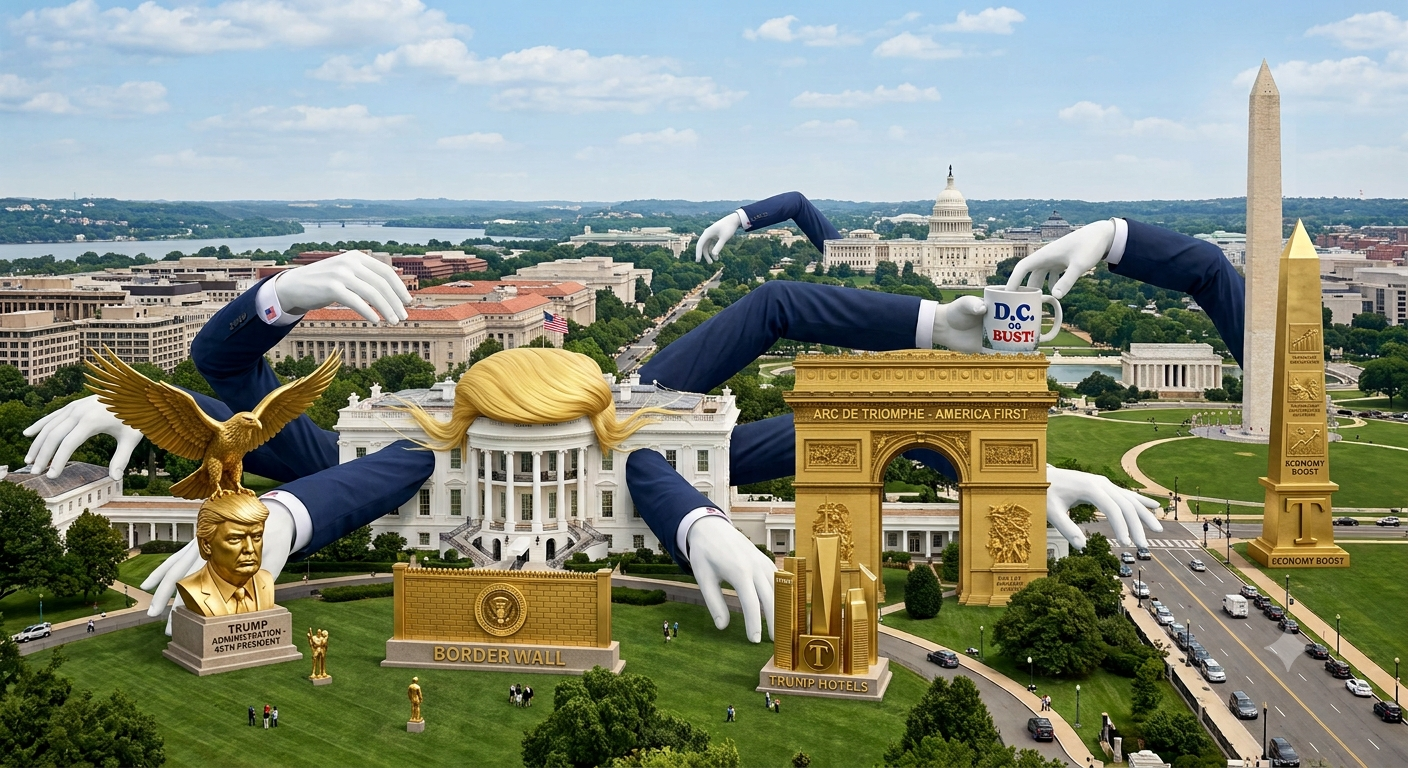
A Brief History of Presidential Overreach and America’s Appetite for Grand Illusions
Every American president inherits the same office. None inhabits the same presidency.
The Constitution imagines an executive whose principal virtues are prudence, restraint, and faithful execution of the law. The political culture, by contrast, increasingly demands something closer to a national redeemer—a figure capable of bending history through sheer force of will. Between those two visions lies one of the defining tensions of the American experiment: presidential overreach.
Overreach is often discussed in constitutional terms. Lawyers debate executive orders. Historians count emergency declarations. Congress complains about usurpations of legislative authority.
Yet another definition may be more revealing.
Presidential overreach is frequently the pursuit of aspirations that vastly exceed the government’s capacity to accomplish them. It is the conviction that sufficiently energetic leadership can conquer problems rooted in economics, culture, technology, or human nature itself.
The American presidency has become not merely powerful but aspirationally limitless. That transformation has been centuries in the making.
Washington’s Exception
George Washington established perhaps the most enduring precedent in presidential history—not through action, but through refusal.
He declined a crown.
He voluntarily surrendered military power.
He left office after two terms despite immense popularity.
Washington understood something many later presidents would struggle to remember: legitimacy sometimes grows from restraint.
His successors inherited an office whose greatest strength was its self-imposed limitation.
That restraint would not survive America’s transformation into a continental—and later global—power.
Jackson and the Cult of Personal Mandate
Andrew Jackson reimagined the presidency.
Instead of viewing himself primarily as Congress’s executive agent, Jackson increasingly claimed to embody the direct will of the American people.
His use of the veto expanded dramatically beyond constitutional objections into questions of public policy. The presidency became less an administrative office than a political one.
The implications have echoed ever since.
Every modern president invokes “the American people” as though they speak with a single voice.
They never have.
Lincoln and the Necessary Expansion
Not every expansion of presidential authority represents folly.
Abraham Lincoln suspended habeas corpus, expanded executive power, and stretched constitutional boundaries under the extraordinary pressures of civil war.
History generally judges these actions differently because they were undertaken in response to an existential national emergency.
But emergencies create precedents.
Future presidents inevitably cite yesterday’s exceptional measures to justify today’s ordinary ambitions.
Power rarely returns to its original size.
Wilson’s Moral Presidency
Woodrow Wilson believed government could elevate humanity itself.
He envisioned making the world “safe for democracy.”
He championed the League of Nations.
He imagined international institutions capable of preventing future wars.
The vision possessed undeniable moral grandeur.
It also reflected a recurring feature of presidential overreach: the assumption that complex societies can be redesigned through sufficiently enlightened administration.
Reality proved less cooperative.
Wilson’s international order fractured almost immediately.
Franklin Roosevelt and the Elastic Executive
No president expanded executive authority more successfully than Franklin Roosevelt.
The Great Depression demanded extraordinary responses.
World War II required even more.
Many of Roosevelt’s innovations became permanent features of American governance because they solved genuine problems.
Yet Roosevelt also demonstrated something future presidents never forgot.
Crisis permits concentration of power.
Subsequent administrations would become remarkably adept at identifying crises.
Johnson’s Great Society
Lyndon Johnson possessed perhaps the most ambitious domestic vision since Lincoln.
His Great Society sought not merely to reduce poverty but to eliminate it.
It aimed to improve education, housing, healthcare, race relations, urban development, and countless other aspects of American life simultaneously.
Some achievements remain enormously consequential.
Medicare fundamentally transformed healthcare for older Americans.
Civil Rights legislation dismantled legalized segregation.
Yet Johnson also revealed a recurring hazard.
Government can construct institutions more easily than it can reshape culture.
Poverty proved more complicated than inadequate funding.
Education proved more complicated than federal programs.
Cities proved more complicated than urban planning.
The aspiration exceeded the available instruments.
Nixon and the Imperial Presidency
By the early 1970s, historian Arthur Schlesinger Jr. coined the phrase “the Imperial Presidency.”
Richard Nixon did not invent executive overreach.
He simply dramatized it.
Watergate revealed what occurs when a president begins believing electoral victory conveys exemption from institutional constraint.
Congress responded by attempting to reclaim authority through oversight, budget reforms, and limitations on emergency powers.
Yet the structural incentives toward executive expansion remained.
Reagan’s Conservative Revolution
Ronald Reagan promised to reduce government rather than enlarge it.
Paradoxically, modern conservatism often expanded presidential authority even while criticizing federal bureaucracy.
Military spending increased dramatically.
Executive influence over foreign affairs continued growing.
The rhetorical commitment to smaller government coexisted with an increasingly powerful presidency.
Political philosophy changed.
Institutional momentum did not.
Bush After September 11
The attacks of September 11 created perhaps the greatest concentration of executive authority since World War II.
Surveillance expanded.
Military operations spread across multiple continents.
Emergency powers became normalized.
Much of the expansion reflected genuine national fear.
Some reflected bureaucratic permanence.
Temporary powers possess an uncanny ability to become permanent institutions.
Obama, Trump, and Biden
The twenty-first century presidency has become increasingly executive by necessity—or by choice.
Barack Obama relied heavily upon executive action amid congressional gridlock.
Donald Trump embraced unilateral authority with unusual openness, often describing Article II powers in expansive terms while testing institutional boundaries.
Joe Biden similarly employed executive authority aggressively on issues ranging from student debt to environmental regulation after legislative avenues narrowed.
Different policies.
Similar institutional logic.
When Congress cannot—or will not—act, presidents increasingly attempt to govern alone.
The temptation transcends ideology.
The New Overreach
Today’s overreach extends beyond constitutional power.
It concerns expectations.
Americans increasingly expect presidents to solve inflation.
Control pandemics.
Repair social media.
Reduce loneliness.
Revitalize manufacturing.
Manage artificial intelligence.
Protect democracy.
Lower prescription prices.
Win trade wars.
Prevent foreign conflicts.
Heal political polarization.
Restore trust.
Preserve the climate.
Secure the border.
Create economic opportunity.
Safeguard constitutional norms.
The list grows longer every election cycle.
No human institution can successfully perform all these tasks.
Yet every campaign promises precisely that.
The Politics of Ridiculous Aspirations
The modern presidency may suffer less from excessive authority than excessive expectation.
Candidates campaign as though elected to command history itself.
Reality eventually intrudes.
Markets ignore speeches.
Foreign leaders pursue their own interests.
Technology evolves faster than regulation.
Culture shifts independently of legislation.
Human beings remain stubbornly resistant to political engineering.
Failure follows—not necessarily because presidents lack intelligence or effort, but because their promises exceed the architecture of government.
This produces a destructive cycle.
Candidates make impossible promises.
Citizens grow disappointed.
Trust declines.
The next candidate promises even more.
Each election raises the stakes.
Each presidency disappoints in proportion.
Recovering Constitutional Humility
The Framers designed a government built upon skepticism—not merely skepticism of kings, but skepticism of concentrated confidence.
They assumed ambition would check ambition because they doubted any individual possessed sufficient wisdom to govern without constraint.
Modern politics often assumes the opposite.
Every four years, Americans search for someone capable of transcending institutions.
History suggests they should instead search for someone willing to respect them.
Perhaps presidential overreach is not ultimately measured by executive orders or constitutional litigation.
Perhaps it is measured by the distance between what presidents promise and what democratic government can realistically achieve.
The greatest danger is not simply an executive who seeks too much power.
It is a nation that continually asks its presidents to accomplish the impossible—and then mistakes inevitable disappointment for institutional failure.
The Constitution never promised an office capable of redeeming history.
Only a republic capable of enduring it.